

Reports
The company-wide job costing reports on the Cost Reports card: the Line Item Report, every DWR line item in a date range before it is invoiced, and the Work in Progress (WIP) Report.
Key Concepts
This page covers the Cost Reports card on the dashboard, which holds the company-wide job costing reports: the Line Item Report and the WIP Report. The dashboard’s other reports card, Time & Expense Reports, has reports of its own; see Time and Expense Reports.
Both reports read work your staff have already entered, so nothing you do on these screens changes a DWR or an invoice. They are for Managers and Administrators: a Technician or a Job Coordinator has no Cost Reports card. See Report Access.
The two start the same way:
- From and To set the date range. Both reports open with a range already filled in and an empty grid. Click Load Data to fill it.
- The range they open on is short: the last two weeks, ending today. Widen From before you click Load Data if you want older work.
- Export to Excel downloads what is in the grid.
The grids are different. The Line Item Report uses the report grid described on Report Grids, with its template toolbar, grouping bar and ⋮ column menu. The grid on the WIP Report has Export to Excel and a funnel filter icon in each column header. There is no template toolbar, so there is no layout to save.
Line Item Report
The Line Item Report lists every line item recorded on a Daily Work Record (DWR) in the date range, so you can see what a period’s work was made of before anyone invoices it.
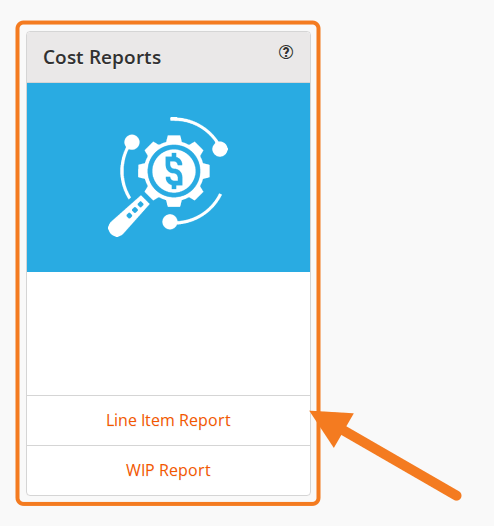
To open it, on the dashboard, in the Cost Reports card, click Line Item Report.
There is one row per line item, with the columns Date, Job #, Line Item, Type, DWR #, Employee, Quantity, Unit, DWR Status and Description. The Date in each row is a link: click it and the DWR the line came from opens in a new browser tab, so you can check a line without leaving the report.
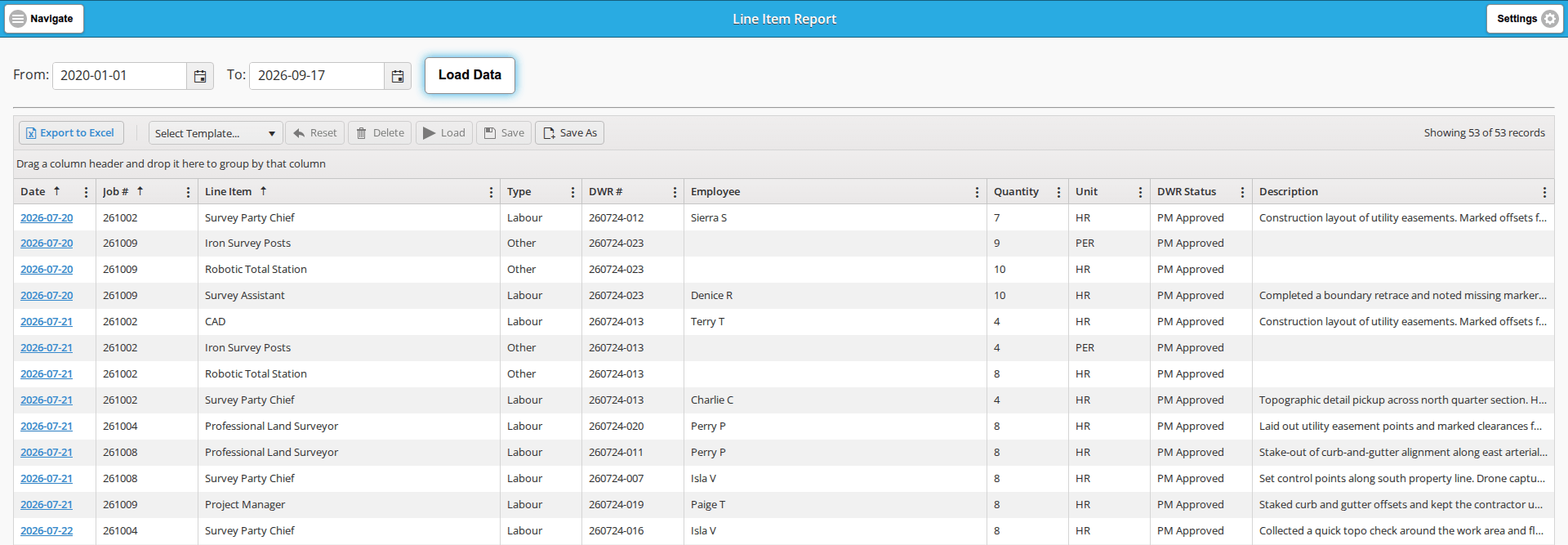
Three of those columns are worth a word:
- Type separates labour from everything else. Labour rows carry the person in Employee; Other rows (equipment and materials, such as Robotic Total Station or Iron Survey Posts) leave Employee blank.
- Quantity and Unit go together: 8 HR is eight hours, 4 PER is four of an item.
- DWR Status is the status of the DWR the line came from, so a row reading PM Approved is work the job’s project manager has already approved.
The report opens sorted by Date, then Job #, then Line Item. Once you change that, only reopening the report from the dashboard puts it back.
Work in Progress (WIP) Report
The WIP Report puts the work recorded on DWRs beside what has been invoiced for the same job, so you can see how much of it is still to bill.
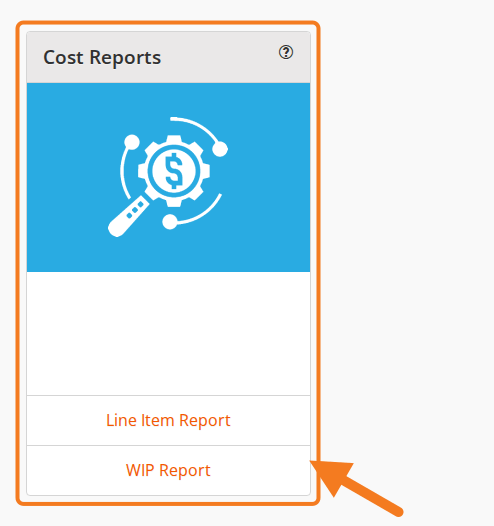
To open it, on the dashboard, in the Cost Reports card, click WIP Report.
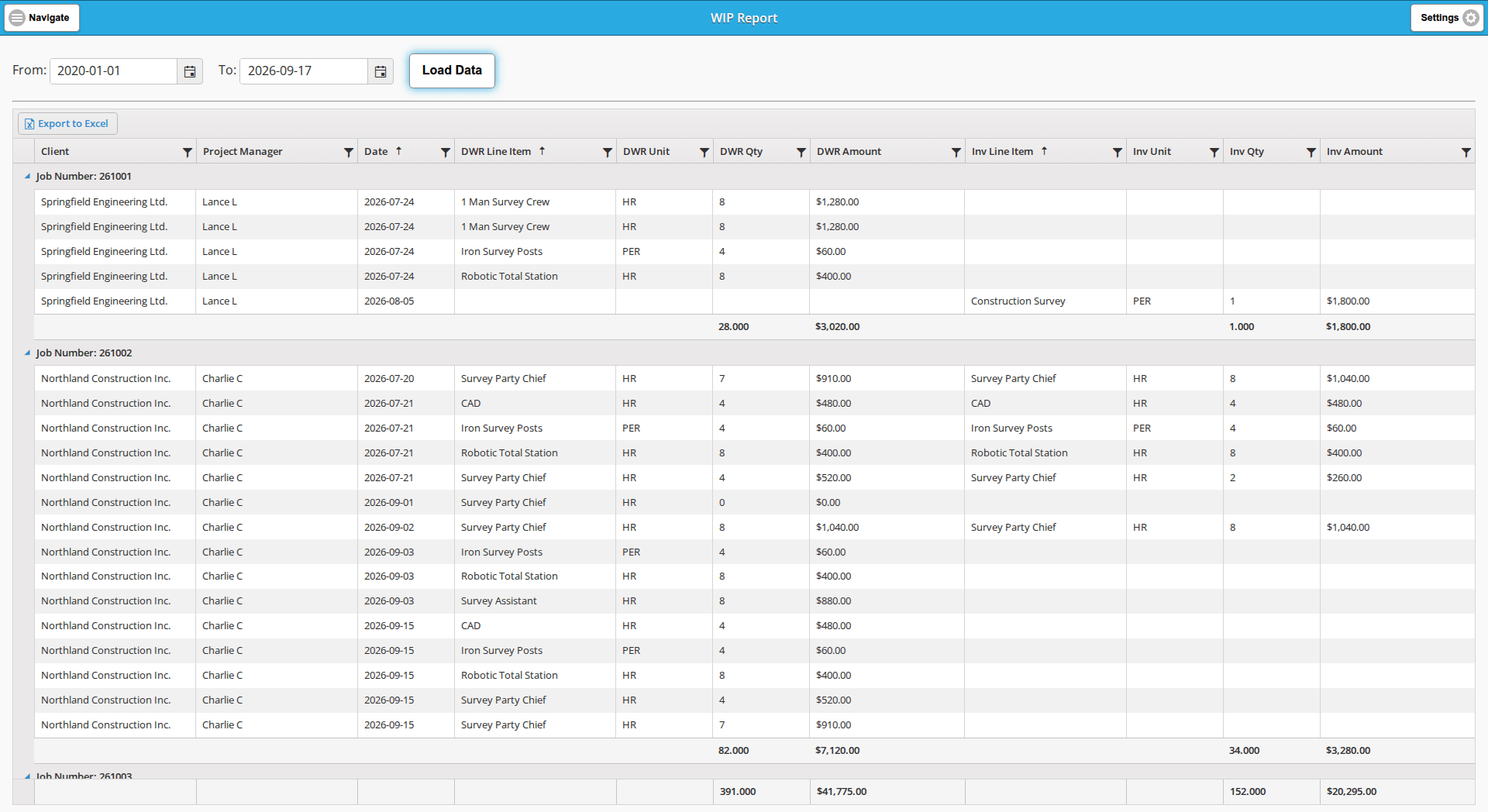
Rows are grouped by job, under a collapsible group header reading “Job Number:” and the job number. Inside a group the columns come in three sets:
- Client, Project Manager and Date identify the row.
- DWR Line Item, DWR Unit, DWR Qty and DWR Amount are what was recorded on the DWR.
- Inv Line Item, Inv Unit, Inv Qty and Inv Amount are what was invoiced.
Read the two halves against each other:
- A row with DWR values and blank Inv columns is recorded work with no invoice line tied to it. On a Time & Materials job that is work still to bill. On a fixed price job it is normal: the DWRs are never invoiced line by line, and the lump sum sits on its own row. Job 261001 above is one: its DWR rows have nothing on the right, and its $1,800 Construction Survey has nothing on the left.
- A row with Inv values and blank DWR columns is an invoice line with no DWR behind it: a fixed-price line, or one somebody added to the invoice by hand.
- A row with both filled in is work that has been invoiced. The two sides need not match: in the picture above, job 261002 has 7 HR of Survey Party Chief recorded and 8 HR invoiced.
Each group ends with a subtotal row totalling DWR Qty, DWR Amount, Inv Qty and Inv Amount for that job, and a grand total for the whole range sits pinned to the foot of the grid. Read the rows in the group before you read anything into the difference: it can be work still to bill, but it can just as easily be a fixed-price line that does not track recorded cost.
Last updated