

Active Job Dashboard
How to read the Active Job Dashboard: the grid of active jobs and its money columns, the invoices behind each row, the job actions, and what is particular to this screen when you sort, filter and group it.
Key Concepts
Administrators, Managers and Job Coordinators use the Active Job Dashboard for an overview of every active job. It brings job status, labour from Daily Work Records (DWRs), expenses and billing together in one view. Most of the screen is the grid of jobs, one row per job, with the money each job has run up so far read straight off the row. It is Job Book’s job costing screen: what each active job has run up and billed so far. What that does for a surveying business is on the Budgeting & Estimates product page; this page is how to read the screen.
Technicians do not get the Active Job Dashboard.
Only active jobs are listed, and these are the columns to read first:
- Job #: the job number, and a link that opens the job.
- Status: where that job sits in your workflow. The values are the product’s fixed list, chosen on the job itself: the jobs below are at Job Setup, Scheduled, Processing and On Hold, and a job that is ready to bill reads Ready to Invoice. The full list is on Job and Client Attribute Tags.
- Billing Type: the job’s DWR Billing Type, one of Fixed Price, Time & Materials, Non-Chargeable or Overhead. See DWR Billing Type.
- Due: the job’s due date.
- PO $: the job’s PO Amount from the job form, the value of the client’s purchase order.
- DWR $: adds up every DWR line on the job, whether or not the DWR has been submitted or approved yet: the labour hours at their billing rates, and the equipment and materials lines with them. This is the job’s burn, the money the work has consumed so far, and the column most people watch.
- Expense $: all reimbursable costs submitted through the expense workflow.
- Invoice $: the total already invoiced on the job.
- Last Invoice: the date of the most recent invoice on the job.
DWR $ and Expense $ are money, not hours: a job with $5,215.00 under DWR $ has that much work recorded against it, not 5,215 hours.
Performing Common Tasks
Opening the Active Job Dashboard
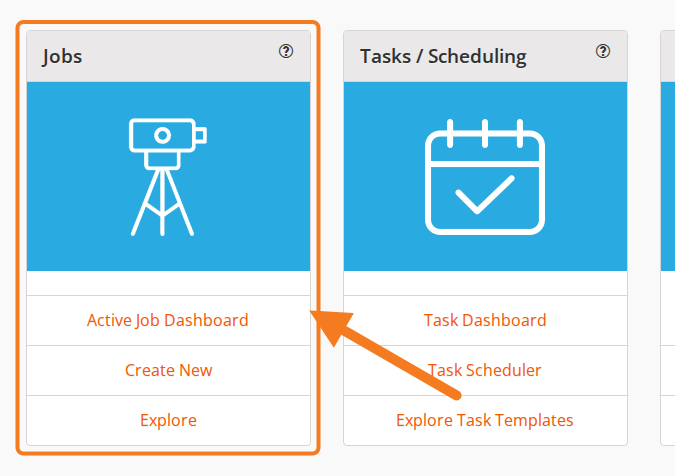
On the dashboard, in the Jobs card, click Active Job Dashboard.
The screen is titled Active Job Dashboard and opens on the whole list of active jobs, sorted by Job # ascending.
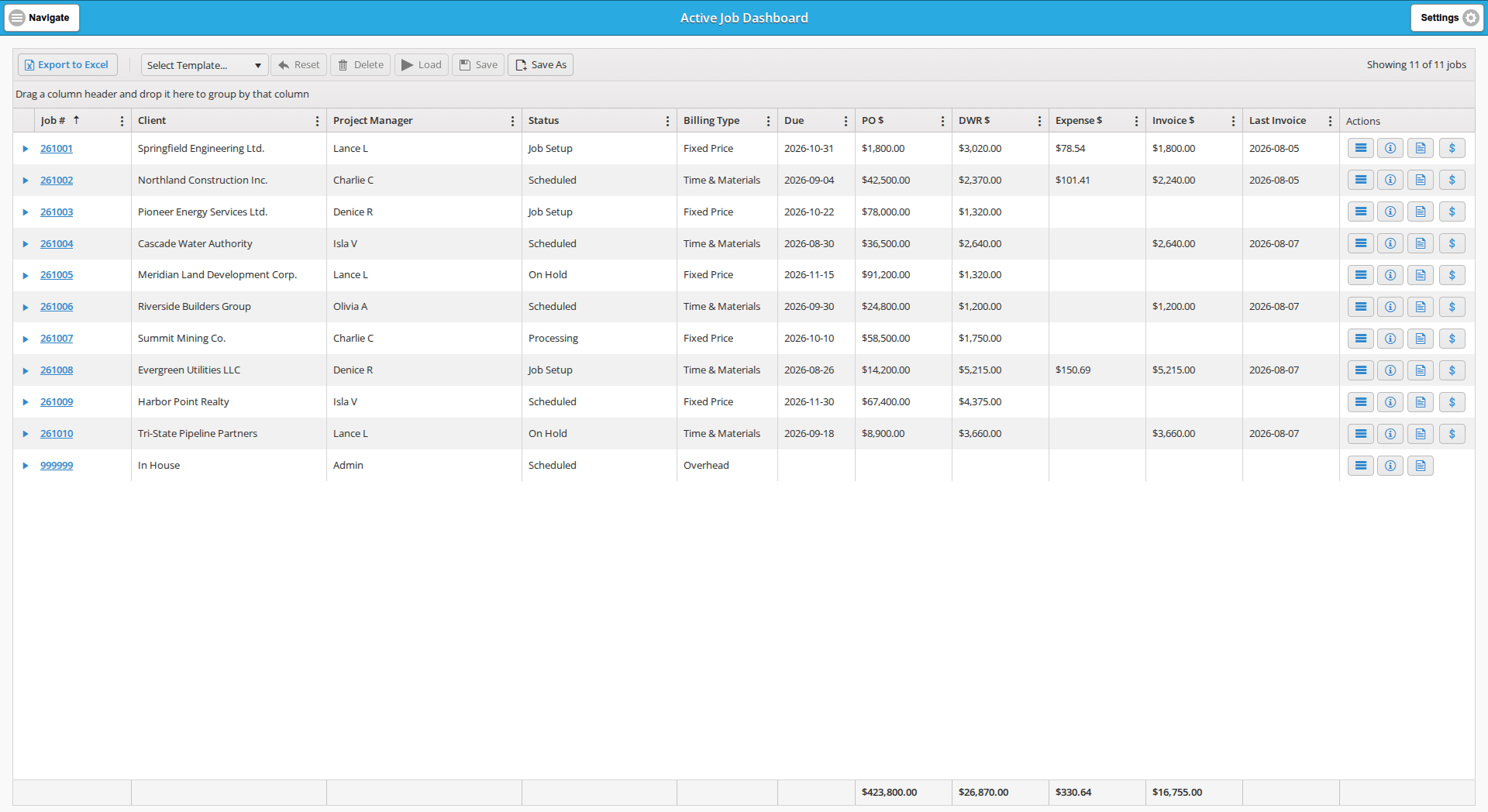
- The toolbar, the grouping bar and the ⋮ column menu are the report grid described on Report Grids. Job # carries the sort arrow the grid opened with, and Actions is the one column without a menu.
- Each Job # is a link that opens that job.
- A row across the foot of the grid totals PO $, DWR $, Expense $ and Invoice $.
Reading the columns
From left to right, the grid shows Job #, Client, Project Manager, Status, Billing Type, Due, PO $, DWR $, Expense $, Invoice $, Last Invoice and Actions.
More columns are available but not shown to start with. Turn them on from the column menu’s Columns checklist:
- Project Name: the project name on the job.
- Ordered: the order date.
- Office: the office the job belongs to.
Money cells are blank rather than zero where nothing has been recorded: job 999999 above is an Overhead job with no PO, no DWRs, no expenses and no invoices, so its money columns are empty.
Seeing the invoices on a job
There is a blue triangle on the left side of the grid, at the start of every row. Click the triangle and the row expands to show all the invoices linked to that job.

The sub-grid’s columns are:
- Invoice #: a link to the invoice.
- Invoice Date: the date on the invoice.
- Acct. Ref: the accounting reference carried on the invoice.
- Labour, Equipment & Materials and Fixed Price: what the invoice came to under each of those three headings.
- Total: the invoice total.
- Paid: whether the invoice has been paid.
A row across the foot of the sub-grid totals Labour, Equipment & Materials and Fixed Price, and ends with the invoice total.
Opening a report or starting an invoice
The Actions column holds four buttons, and each one is specific to the job on that row. They are icons, so hover one to read its title. From left to right:
- Job Charge-Out Rate Report, Summary Report and History Report: the three reports every job carries, described on Job Reports. They only read what is already recorded.
- Create Invoice: starts the billing for the job. It is not displayed on a Non-Chargeable or Overhead job, so those rows carry three buttons instead of four.
Sorting, filtering, grouping and templates
Sorting, filtering, choosing columns, grouping, templates and Export to Excel are all described on Report Grids. What is particular to this screen:
- To see only the jobs you manage, filter the Project Manager column with Starts with and your name.
- DWR $, Expense $ and Invoice $ take the number operators, so Is greater than and the like are on offer. PO $ takes the text operators instead.
- Group by Client or Project Manager to read the money columns one client or one manager at a time.
Best practices
- Update job statuses as soon as milestones change, so everyone can see which jobs are moving and which are waiting.
- Deactivate jobs when they complete, so staff don’t accidentally book time to completed jobs. See Activating and Deactivating Jobs.
- Make sure new jobs include budget quantities, even for Time & Materials work, so the Summary Report can compare what has been recorded against what was budgeted.
- Encourage technicians to enter their DWRs and submit their expenses every day. Otherwise DWR $ and Expense $ fall behind reality.
- Check the dashboard every morning to spot issues before crews leave the office.
- Watch for jobs carrying recorded work but nothing invoiced. Create Invoice, in the Actions column, is where the billing starts.
- Read DWR $ against PO $ before a client call. That is burn against budget, and it is where a job running over shows up first.
- Put a recurring dashboard review in the calendar with your project managers and administrators.
Video
 Coming soon
 Last updated