

Invoicing a Time & Materials Job
How an Administrator turns approved DWRs into draft invoices from the DWR Invoice Backlog: the columns, grouping by job, Invoice Selected DWRs, undoing a mistake, and where the new invoice goes next.
How a time and materials invoice is built
A time and materials invoice, or T&M invoice, charges the client for the actual time spent and materials used. A job billed for a fixed amount instead is covered on Invoicing a Fixed Price Job.
A time and materials invoice takes work to build by hand, because every hour worked and every material used has to be tracked, and a Daily Work Record (DWR) left off an invoice is revenue you never collect. Job Book collects the approved DWRs into one place, the DWR Invoice Backlog, and from there you generate draft invoices for the job’s project manager to approve. This page is about working it. What the DWR-to-invoice chain does for cash flow is on the DWR, LEM & Invoicing product page.
- Why the backlog matters: every approved DWR is work your team has already delivered, and until it is on an invoice it is unbilled. This is the last look at the quantities and rates before they reach a client.
- What lands in it: every approved DWR that belongs to a Time & Materials job and has not been invoiced yet. The billing type is set on the job as DWR Billing Type; see Job Setup. A DWR gets there by being approved; see DWR Approval.
- Who works it: typically an Administrator converts the DWRs for Time & Materials jobs into draft invoices, for the job’s project manager to review and approve.
- What comes out: one draft invoice per job, in the PM Queue, from where it lives the same life as any other invoice. That life, the Invoices list and the invoice form are all on Invoices.
- The backlog is not the only way in: a new invoice started from the Invoices card on a Time & Materials job offers the same DWRs under Invoice Contents:, and adding them fills the tabs the same way. The backlog does it in a batch; see Creating an invoice.
Invoice Creation
Opening the DWR Invoice Backlog
On the dashboard, in the Workflow card, click DWR Invoice Backlog.
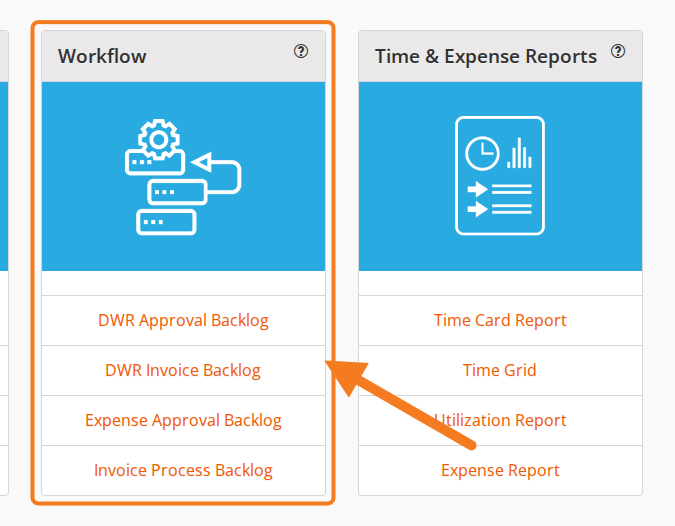

Invoice Selected DWRs is at the top left and Expand All and Collapse All at the top right. The grid is the one the backlogs share: ticking rows, the batch button, sorting, grouping, the funnel filter, the filter row and expanding rows are all described on Backlog Grids.
Reading the backlog
The columns are Date, Created By, DWR #, Job #, Client, Project Manager and Office. The DWR # column contains hyperlinks to the individual DWRs.
This backlog has no undo button: an invoice created by mistake is dealt with under If you made a mistake.
Invoicing DWRs from the DWR Invoice Backlog
- Review the DWRs first. Expand a row, or click Expand All, to see the line items behind each one.
- If it helps, group or filter the grid first, for instance by dragging the Job # column header onto the grouping bar so each job’s DWRs sit together.
- Tick the DWRs you want to generate an invoice for. Several DWRs ticked for the same job all go onto one invoice, and DWRs ticked for several different jobs generate one invoice per job.
- Click Invoice Selected DWRs. The confirmation names the number of DWRs you are about to turn into an invoice. Click OK.

The selected DWRs have now generated an invoice, and they disappear from the backlog immediately. A green popup names the invoice number and the job it was created for, with a button on it that opens the new invoice in a new browser tab. The invoice itself lands in the PM Queue.
If you made a mistake
If an invoice was generated in error, delete it and the DWRs come back:
- On the dashboard, in the Invoices card, click Explore.
- Open the invoice that was generated.
- Click Delete, and confirm.
Once the invoice is deleted you are back on the Invoices list, and the DWRs used to create it are in the DWR Invoice Backlog again.
Checking the new invoice
A generated invoice is a draft in the ordinary invoice form, described field by field under The invoice form. Open it from the popup’s button, or from the PM Queue view of the Invoices list. What is different about a draft built from DWRs is that it arrives filled in: Invoice Contents: lists the DWR numbers it was built from, and the Labour Costs and Equipment and Materials tabs already hold their lines. Check the quantities, the unit costs and the descriptions the client will see, and adjust a row where the billing differs from what was recorded. Changing a row here changes only the invoice; the DWR and payroll are unaffected.
Where the new invoice goes
The draft waits in the PM Queue for the job’s project manager to review it and add a Representative Signature. From there it follows the same path as every invoice, on Moving an invoice to the next stage.
Best practices
- Keep every step of the chain moving: field teams create DWRs, the job’s project manager approves them in the DWR Approval Backlog, an Administrator converts the approved DWRs into invoices here, the project manager signs the draft and an Administrator delivers it. The Active Job Dashboard stays current through all of it.
- Schedule a billing block every week, so the backlog never grows stale.
- Use the grouping bar or a filter to process one client at a time during month end. Sending one package per client reduces back-and-forth questions.
- After each billing session, refresh the grid and look at what is still there. Every DWR left in the backlog should be one you chose to hold back.
Video
 Coming soon
 Last updated