

· gospel according to dan · 10 min read
Why we built a free Proposal Builder for surveyors
Rule 18: Hourly rates with an estimate seldom make money.
Remember that when I’m talking of making money, I’m talking about profit, not revenue.
Twenty years ago, a typical situation went something like this: A client would come into the surveyor’s office and request an estimate for a survey. The surveyor would provide an estimate and the client would inquire as to how close that estimate was. The surveyor would tell her that he would let her know if the costs would exceed his estimate. (Of course, there is no way of knowing the estimate will be exceeded until it already has been exceeded.)
The surveyor would proceed to do the work, and at the end of the month tally up the charges, and find that the estimate was exceeded by 40%. What to do? The usual routine was to send the bill and hope she would pay the full amount – after all, it was only an estimate. (The surveyor rationalizes this decision, because from time to time it has worked, but he really knows that most clients won’t be happy with this and will object.)
Sure enough, when the client gets the bill, she objects, stating that the surveyor was supposed to let her know if the estimate was exceeded. The surveyor admits that he should have let her know, but makes a lame excuse (such as “I don’t get all the time posted to the job until the end of the month”) as to why he didn’t. The client and the surveyor end up negotiating a settlement, usually somewhere near the original estimate.
If the surveyor had any profit built into his rates (highly unlikely), that profit is now gone and, in fact, the project probably ends up losing money for the surveyor. He would have been better off financially and otherwise had he not done the work at all.
Remember Rule No. 11? The surveyor offended 250 people and none of them will be business prospects in the future. The sad part is the next client that came along was probably treated the same way.
Surveyors are more sophisticated these days, but I fully suspect that this scenario is replayed all over the country on a daily basis.
Stay away from hourly rates when possible – they can kill you.
Rule 19: Lump sum fees are the only way for a surveyor to make an extraordinary profit.
Some might argue that making an extraordinary profit is not ethical behavior for a surveyor. I completely disagree. For the good of the profession and the good of the surveyor, profits are OK. This is still a free-market economy, in principle.
Remember the situation I was addressing earlier where a surveyor can accomplish a survey of some very valuable property very easily. The liability he incurs is proportional to the value of the property, but the work might not be. I think he is entitled to an extraordinary fee in such a situation. That’s only one example, of course, and there are many more, but it will serve to illustrate the rule.
If the surveyor, in the situation illustrated, charges his normal hourly fees, he will be reimbursed only for the actual work done, not for the value of the work.
However, if the surveyor had quoted a fixed fee, well in excess of the cost of the work required, he could have realized a tidy profit on the job. Moreover, assuming he performed as he should have, he would not have alienated the client or any of the 250 other people alienated with the hourly rate proposal.
If you want to make money, use lump sum fees.
The worst of both worlds
Rule 18 describes a trap that almost every surveying firm has been caught in at some point. You give the client an “estimate,” you do the work, the work goes over, and now you’re stuck. Either you eat the overage, or you send a bill that starts a fight.
The reason this hurts so much is that “hourly rate with an estimate” is the worst of both worlds. You’re carrying all the price risk that comes with hourly billing, and the client is sitting there expecting all the certainty they thought they were buying with a quote. You promised a number you can’t actually control. The client heard it as a number you committed to. When reality lands somewhere in the middle, somebody has to be unhappy about it. Usually both of you.
Pure hourly at least lets you bill what you actually worked. A pure fixed fee at least gives the client the predictability they were paying for. The hybrid gives nobody anything except an uncomfortable conversation at the end of the month.
So why do we keep doing it?
Because estimating in hours is how surveyors actually think about work, and quoting hours feels honest. A surveyor planning a job has a real feel for how much time the field work will take, how much time drafting will take, how much control the site needs. That math is real, and it’s the right way to figure out whether a job is worth doing. The mistake isn’t doing the math. The mistake is showing it to the client.
A client doesn’t want to buy hours. They want to buy a survey. They want to know what it costs and when they get it. Whether it took you eight hours or eighty is your problem to solve, not theirs. The minute hours show up on the proposal, you’ve invited the client into a conversation they were never qualified to have. They start second-guessing your crew size, your equipment, your drafting time, and you end up defending your process instead of selling your work.
The internal vs. external split
The fix for Rule 18 is splitting your estimate in two:
- Internal estimate. The spreadsheet. Roles, hours, rates, contingency, disbursements, all the numbers you need to know whether the job is worth doing. Nobody outside your firm ever sees it.
- External quote. What the client sees. A fixed fee, broken into a few plain-language line items, with clear deliverables and clear payment terms. No hours, no rates, no math.
The internal layer protects you from underbidding. The external layer protects the client relationship from the messy reality of how the sausage gets made. Neither one works without the other. Skip the internal estimate and you’re guessing. Publish the internal estimate as your quote and you’re back to Rule 18.
Dan describes exactly this workflow in the Making Estimates chapter of the Handbook. He walks through a worksheet for a topographic survey: field hours by role and rate, office hours by role and rate, a 10% line for project administration, totals at the bottom. Then he says something most surveyors skip right past:
With a little effort this estimating worksheet can be made to work almost automatically… I have been able to set up an estimating template that not only produces the estimate but writes the contract at the same time, so it’s just a matter of printing the contract.
That’s the workflow every firm should be using. One set of numbers, two outputs: an internal sheet that tells you whether the job is profitable, and a client document built from the same numbers. Estimate privately, then hand the client a fixed fee and a written scope. Not a list of hours.
That document is doing more work than it looks like. A proper proposal restates the scope in plain language so misunderstandings surface before work starts, locks in the fee so nobody is doing math at the end of the month, and spells out payment terms (including any retainer up front, see Rule 12: surveyors should collect fees up front). Skip any one of those and you’re back to “negotiating a settlement, somewhere near the original estimate.”
How to actually do this
If you’re still doing proposals in Word and pricing in Excel, and most firms still are, the gap between knowing this and doing it is wider than it should be. Every new job means re-checking that the rates in the spreadsheet are current, remembering whether this particular client has their own rate, and digging up the most recent version of whichever template is closest to the job. Standardizing the output across a team is hard. Delegating proposal work without losing the firm’s voice is harder.
And then there’s how it looks. The proposal is usually the first thing a prospective client sees with your name on it, and a Word document in default Calibri, with the stock table headers and a logo dropped at the top, isn’t broken. It just looks like a Word document. Most surveyors already know their proposals don’t look as good as the work itself. Fixing it means becoming a part-time graphic designer, which nobody has time for, so the template stays the way it is and every proposal goes out with a quiet apology attached to it in the surveyor’s head.
The other half of the problem is what happens after the proposal goes out. Most firms don’t have a clean way to see which proposals are still sitting in a client’s inbox, which came back as wins, and which quietly went cold. And almost nobody has a feedback loop from actual job costs back to the next estimate, which is the only way the internal math ever gets more accurate over time.
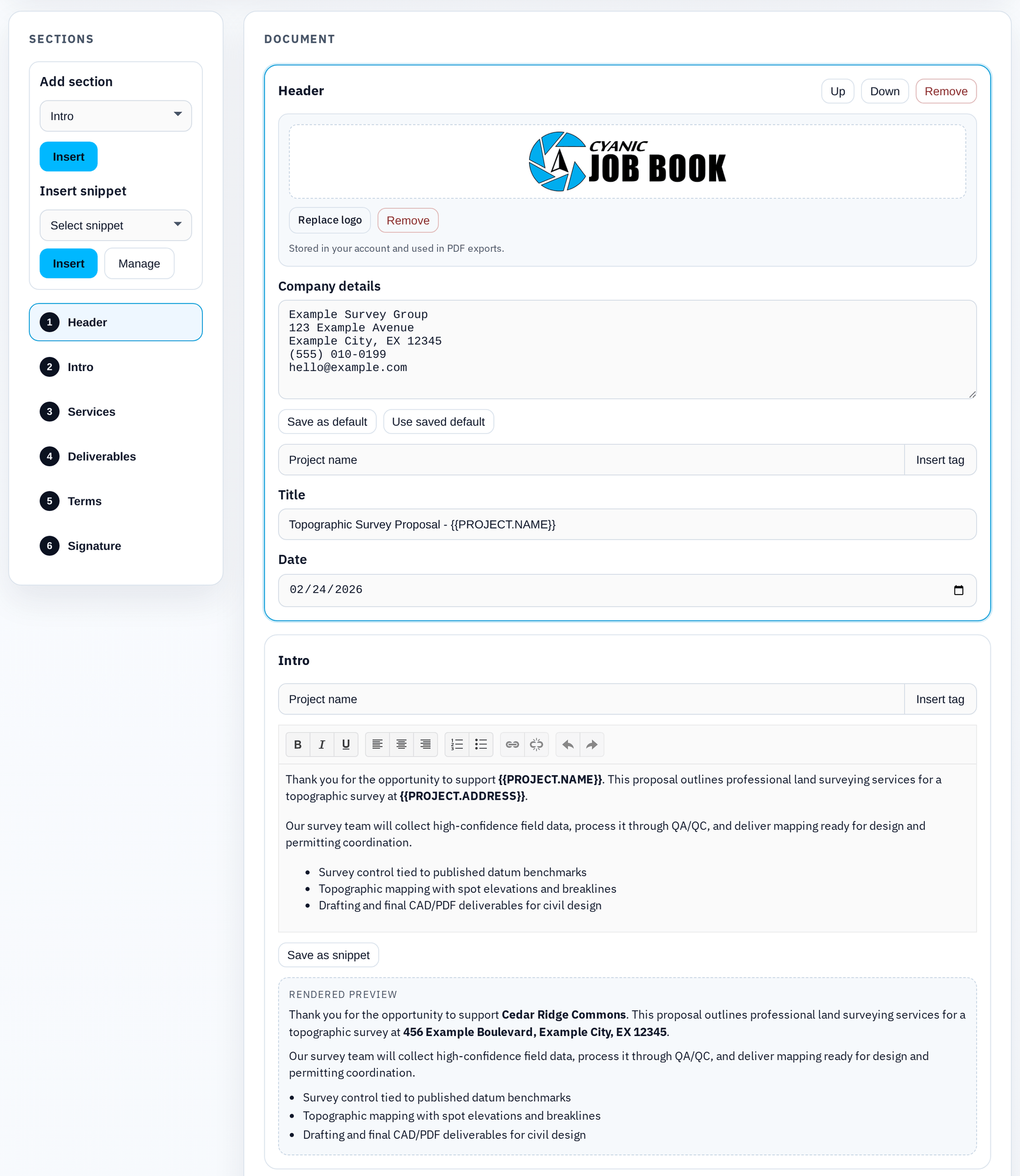
We built a free Proposal Builder for exactly this problem. It’s the workflow Dan described in 2003, with the rough edges sanded off.
- The Estimate Assistant lives inside the proposal. You set up roles and rates, lay out tasks and hours by role, add a contingency percentage, and itemize disbursements for travel, equipment, mileage, and anything else you need to recover.
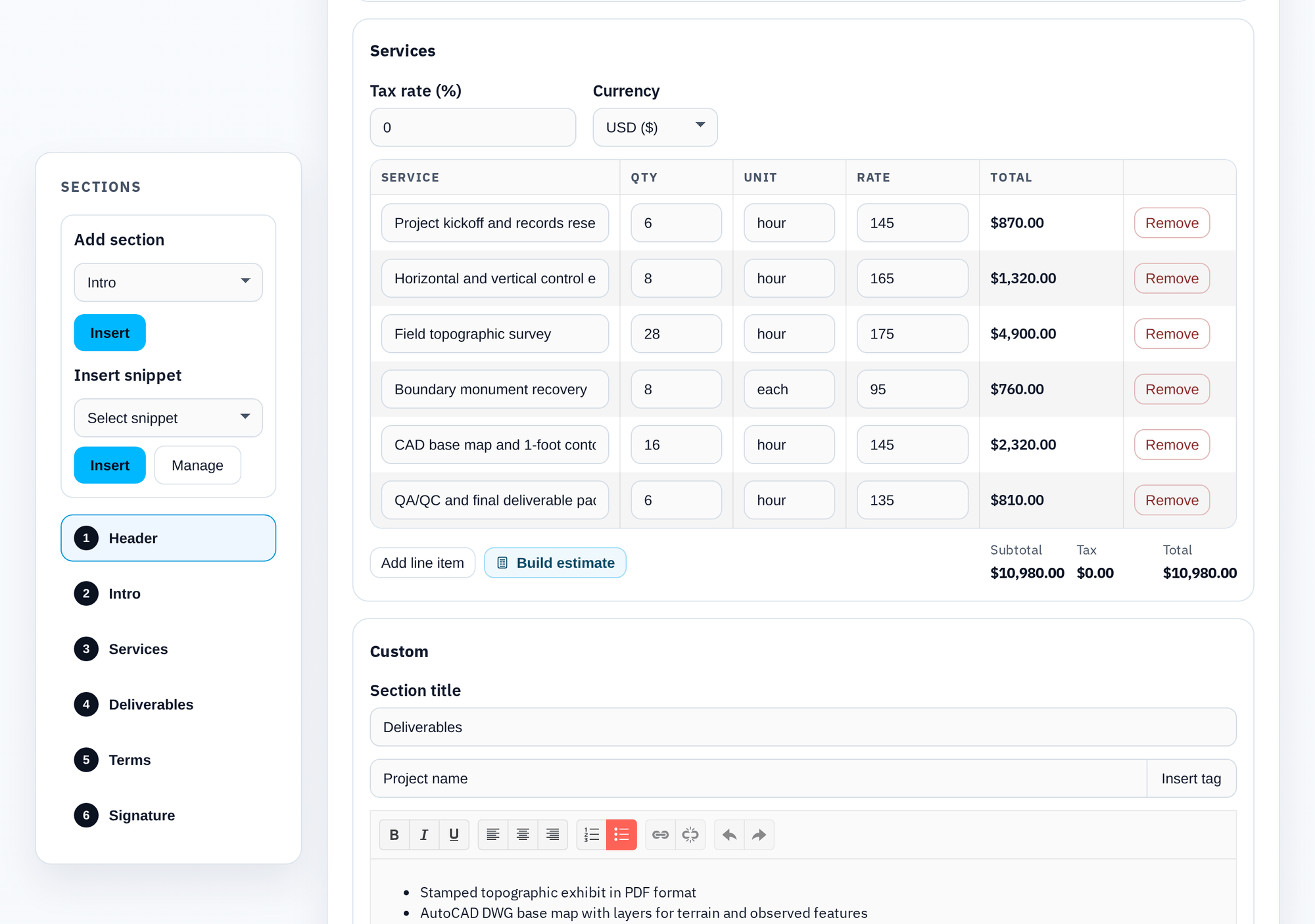
- One click converts your internal estimate into service rows on the proposal. You can show the client a detailed breakdown or a single rolled-up labor line, and the math stays the same either way.
- Reusable section templates and snippets save your standard scope language, terms, and payment language, so the proposal really does write itself alongside the estimate.
- Status tracking tells you which proposals are out, which came back, and which need a follow-up.
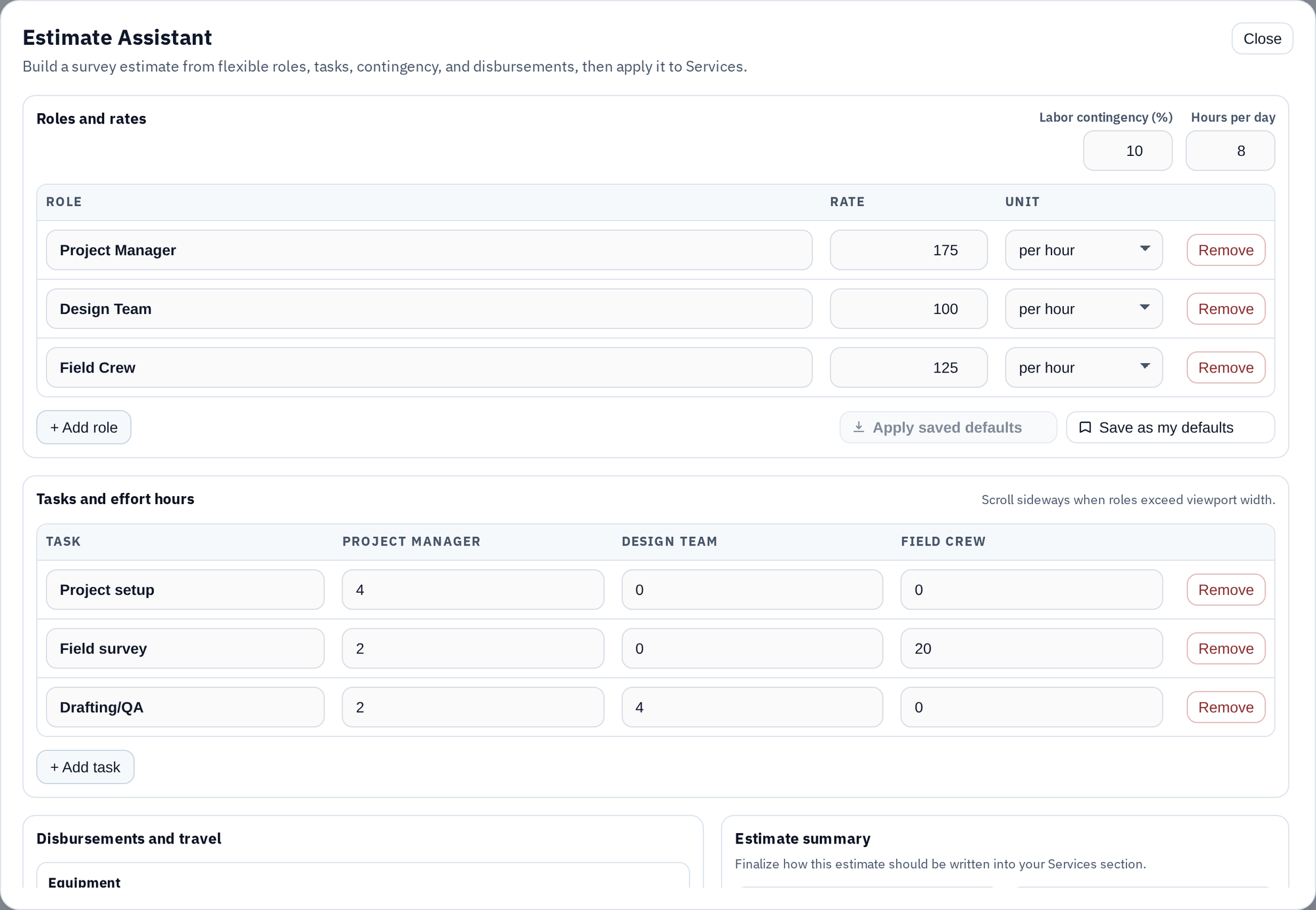
The estimate above never leaves your firm. What the client sees is the Services section it generates. A fixed fee, broken into plain-language line items, with the math tucked away behind the numbers.
It’s free, it’s built for surveyors, and you don’t need an account to start. If you’re tired of shuffling between Word and Excel, give it a try.
The tool is the easy part. The hard part is the discipline. Estimate in hours so you know your costs, then quote a fixed fee so you keep your profit and your client’s trust. That part you still have to do yourself.
If you want to make money, use lump sum fees.